
Psychoanalytic Theories

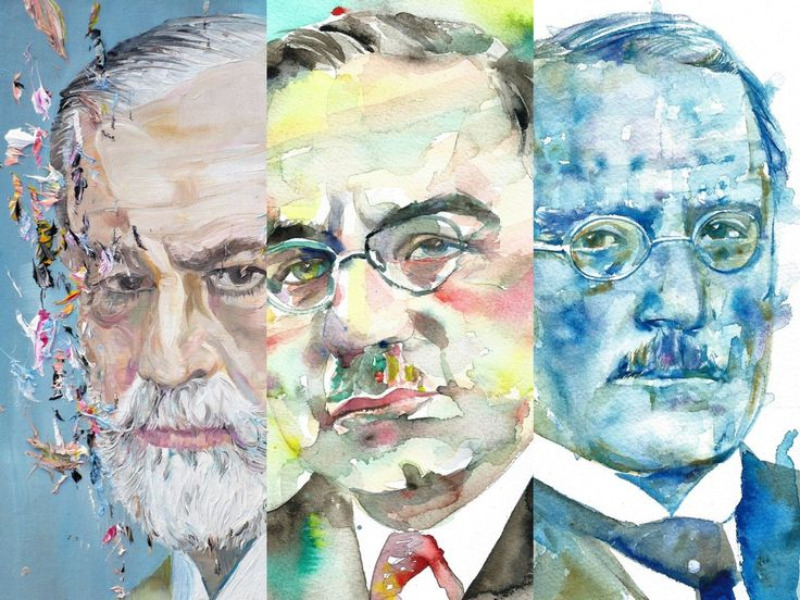
Major Theories in Psychoanalysis
Classical Approaches and Evolving Views on Personality and the Unconscious
Psychoanalysis is one of the most influential personality theories of the 20th century. Originally developed by Austrian neurologist Sigmund Freud from his clinical studies of neuroses, it evolved into a comprehensive framework for understanding human personality development and functioning. Below, we review the core theories and contributions of major psychoanalytic thinkers:
Sigmund Freud: The Unconscious, Instincts, and Inner Conflict
Freud’s theory was grounded in the idea that many neurotic symptoms (such as hysteria or obsession) arise from unconscious conflicts between instinctual drives—especially sexual ones—and the mind’s defensive mechanisms. He observed that many patients were unaware of the origins of their symptoms and seemed emotionally detached from them.
Freud and his colleague Josef Breuer hypothesized that such symptoms stemmed from painful early childhood experiences, often of a sexual nature, which had been repressed from conscious awareness but returned in symbolic form. Even when these experiences were not objectively real but remained in the realm of fantasy, Freud saw them as significant expressions of instinctual conflict.
Freud introduced a structural model of the mind consisting of three parts: the id (primitive instinctual drives), the ego (the rational mediator), and the superego (internalized moral standards). Personality and mental disorders were seen as outcomes of the dynamic balance—or imbalance—between these three psychic agencies.
He also described defense mechanisms such as repression, displacement, reaction formation, projection, and isolation, by which individuals unconsciously manage unacceptable desires. For example, compulsive hand-washing might mask an unconscious obsession with moral impurity.
Freud proposed a psychosexual model of development comprising oral, anal, phallic, latency, and genital stages, each contributing to personality formation. Failure to resolve conflicts at any stage, he believed, could leave lasting imprints on adult character.
Carl Gustav Jung: Collective Unconscious and Archetypes
Swiss psychiatrist Carl Jung, one of Freud’s early followers, agreed on the importance of the unconscious but disagreed with Freud’s emphasis on sexuality. Instead, he emphasized symbolic, spiritual, and collective dimensions of the psyche.
Jung introduced the concept of the collective unconscious, a deeper layer of the unconscious mind shared by all humans and filled with archetypes—universal images and patterns such as the Hero, the Shadow, and the Mother.
He also distinguished between introversion and extraversion as two fundamental personality orientations. Jung’s ideas laid the foundation for analytical psychology and modern personality typologies.
Alfred Adler: Inferiority Complex and Compensation
Adler, another early associate of Freud, rejected the primacy of sexual drives and focused on feelings of inferiority and the striving for superiority. He argued that individuals, particularly those who experience early physical or emotional limitations, seek to compensate by developing strengths in other areas.
For instance, a child who feels physically weak might grow into an assertive or dominant adult in an effort to overcome early insecurities. Adler also emphasized birth order and family dynamics as key factors in personality development.
Erik Erikson: Psychosocial Development Across Eight Stages
American psychoanalyst Erik Erikson expanded Freud’s theory by integrating psychological, social, and biological dimensions. He proposed a lifespan model of eight stages of psychosocial development, each characterized by a core conflict:
-
Trust vs. Mistrust (Infancy)
-
Autonomy vs. Shame and Doubt (Toddlerhood)
-
Initiative vs. Guilt (Preschool age)
-
Industry vs. Inferiority (School age)
-
Identity vs. Role Confusion (Adolescence)
-
Intimacy vs. Isolation (Young adulthood)
-
Generativity vs. Stagnation (Middle adulthood)
-
Integrity vs. Despair (Old age)
Erikson believed that unresolved conflicts in one stage could hinder development in later stages and contribute to personality difficulties.
Despite significant differences among psychoanalytic thinkers, they share a core belief: that human behavior is deeply shaped by unconscious processes, early childhood experiences, and the dynamic interplay between drives, societal expectations, and defense mechanisms.
Source:
https://www.britannica.com/topic/personality/Psychoanalytic-theories


